

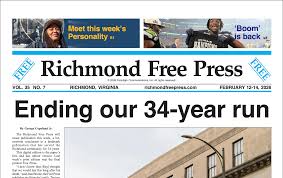
For more than three decades, the Richmond Free Press stood as a trusted witness to history in Richmond, telling stories that too often went unheard. Founded in 1992 by journalist Raymond H. Boone Sr., the weekly newspaper became a cornerstone for readers seeking coverage rooted in accountability, dignity, and the lived experiences of Black Richmonders. This month, after 34 years of publication, that voice has gone quiet.
The paper’s closure was not due to a lack of relevance or readers. Instead, it was driven by the same forces reshaping local journalism across the country. Advertising revenue—the lifeblood of most local newspapers—dried up as businesses shifted marketing budgets to digital platforms. Rising costs, changing media habits, and an unforgiving economic environment made it impossible for the paper to continue.
Yet the loss of the Richmond Free Press is more than a business story. It is the loss of an institution that helped document the life of a community and hold power to account. Over the years, the Free Press broke and advanced important local stories that led to real change. Its reporting exposed a Richmond judge’s racist online comments, prompting the judge’s resignation. Its coverage helped bring attention to a wrongful conviction case that ultimately resulted in a gubernatorial pardon. And its reporting on discriminatory language in city code helped push officials to rewrite policies to be more equitable.
These were not isolated headlines. They were examples of the steady watchdog journalism the Free Press practiced week after week. Under Boone’s leadership—and later under publisher Jean Patterson Boone—the paper built a reputation for fearless reporting on housing inequities, voting rights, education disparities, and Richmond’s cultural life. It chronicled protests and parades, church anniversaries and political turning points, celebrating a city’s resilience while never shying away from its unfinished work.
For many readers, the weekly edition was more than a newsprint. It was recognition. It was proof that their stories mattered. Black-owned newspapers have historically documented civil rights struggles, challenged injustice, and preserved cultural memory when others would not. The Free Press carried on that tradition, nurturing young journalists and amplifying voices that might otherwise be overlooked.
Its closing comes during a difficult chapter for local journalism nationwide with almost 2,000 community newspapers closing across the US in 2025. Thousands of newspapers have shuttered or shrunk in recent decades, leaving communities with fewer watchdogs and fewer storytellers. But the disappearance of a Black-owned newspaper carries particular weight, especially in a city whose history is so intertwined with the nation’s story of race and democracy.
What comes next is uncertain. New digital platforms may rise, community newsletters may grow, and independent reporters may step forward. But their success will depend on whether readers, businesses, and civic leaders recognize that strong local journalism requires sustained support. Subscriptions, advertising, and community partnerships all play a role in keeping vital reporting alive.
The presses may have stopped, but the legacy of the Richmond Free Press endures—in the conversations it sparked, the truths it told, and the community it served.